
Author: Janet Chester Bly

  • How to Forgive Those You Love

    How to Forgive Those You Love

    Forgive Those You Love 

    Forgiveness is tough. After a talk I gave in Michigan, a lady approached me. “That was great on forgiveness, but I have a difficult situation. I really can’t get over it. I can’t forgive my mother-in-law.” “What happened?” I asked.  

    “Well, on the day we got married seventeen years ago, in the reception line we shook hands with everyone. Some friends of my husband’s parents came by and after we were introduced, they walked over to my new in-laws. I could hear their conversation.” After a sigh, she continued. “The friend said, ‘She seems like such a lovely girl,’ and my mother-in-law replied, ‘Well, she’s certainly not who we would have chosen for him!’” I haven’t spoken to her since.

    Seventeen years. That that was a horrible thing to say. It’s also awful to not forgive after all that time. Think of all the work not forgiving would take. She had to plan her holidays around ignoring her mother-in-law. She’d have to figure out when not to answer the phone because it might be her.  Perhaps you aren’t in a situation that drastic, but forgiveness challenges everyone.  

    Forgiveness is Difficult

     First, we’re selfish, unloving, dependent people. That’s the old nature with which we’re born. Little children display selfishness. Their worlds center around them. We see that in our grandchildren. They may be the cutest kids in the world. But if Susy plays out in the sandbox and little Buford dumps sand on her head, she will say, “I wish you were dead.” You come running out and say, “Now, Susy, you didn’t mean that.” She insists, “I do too.”

    If you’re children are different, it’s because they’ve learned that.  As adults, we still have that old nature inside us. We’re basically selfish and don’t want to let others off the hook. We want everything to center around us and they’ve destroyed something in our world. And we’re not quick to forgive. 

    Other Reasons

    Second, something precious has been taken away. Trust has been shattered or destroyed. You depended on them to behave in a certain way and they didn’t.  

    Third, sometimes in marriage a spiritual bond has been broken. That’s why Jesus said, “The two shall become one flesh.”  “What therefore God has joined together, let no man separate” (Matthew 19:6).  He meant that you could separate, but no one should. Some things happen that rip apart that oneness, that bond.  

    Fourth, forgiveness doesn’t happen quickly nor change everything instantly. It’s often a process. If saying, “I forgive you,” changed them. If they threw off all their bad habits, became perfect so they never did bad stuff again, forgiveness would be easier. But it doesn’t always change things. Not quickly, anyway. Nor does offering forgiveness remove consequences. So, we’re hesitant. Yet we must do it.  

    Why We Need to be Forgiving People

    For the offender’s sake. In a marriage, it’s for your mate’s sake. God has given you and me unlimited forgiveness. We keep blowing it, making mistakes. He gives us new chances to start all over again, to get right with God. Others need that opportunity too. 

    For our own sake. Lack of forgiveness leads to bitterness, which destroys us. Think of the lady mentioned above who didn’t forgive her mother-in-law for seventeen years. Who do you think has been hurt most? I’m not sure, but it’s at least even.  

    For the gospel’s sake. We’re commanded to forgive. It’s our duty. The Scriptures say we have to do it, whether we feel like it or not. Paul writes in Ephesians 4:32, “And be kind to one another, tenderhearted, forgiving each other, just as God in Christ also has forgiven you.”  

    For our witness’ sake. If it’s your desire to share your faith, tell others about Jesus Christ, then forgive. If it’s your purpose to share your faith with your neighbors and friends, lack of forgiveness weakens your witness completely. 

    We must also forgive for many other people’s sake. Those on the periphery of the situation suffer too. If a spouse isn’t forgiven, how does that affect the children, their health, at school, relationships to you and other kids? Unforgiveness affects more than you and the offender.  

    WHAT TO REMEMBER 

    Fact 1 – forgiveness does not always require confession and repentance first. Sometimes we wait to forgive until they come to us and ask for it. We want them to come and say, “I’ll never, ever do that again.” Of course, that would be ideal. We long to hear, “I was wrong and I’m sorry. I made a mistake.” But you don’t have to wait for that in order to be a forgiving person.  

    On minor offenses, it’s a bit easier to overlook them. If a neighbor backs out of his driveway and doesn’t see you, but you have to swerve and hit a garbage can to miss him, that might not be hard to forgive without accosting him. But we can forgive big things before a confession too.  

    Jesus looked down at the Roman soldiers around the cross and prayed, “Father, forgive them for they do not know what they are doing” (Luke 23:34). 

    These people never once looked up at Jesus and said, “I’m sorry for crucifying you. We will never, ever let something like this happen again.” As far as we know, they had no remorse in their hearts. Yet, Jesus offered them forgiveness. There are times in your life when you can offer forgiveness before it’s even asked for.  

    Repeat Offenders

    Fact 2 – some offenses require repeated forgiveness.  

    Jesus’ disciples ask if they must forgive seven times, the common rule of the day, to which He replies, “Up to seventy times seven” (Matthew 18:21,22). He meant they should go on forgiving. 

     Suppose you’ve got a sore toe, one that’s sprained or broken, and you’re on the sidewalk visiting with people. And a kid comes down the sidewalk on a skateboard. You step back to let him pass by and he sways a bit and about loses balance, then straightens and rides right over your bad toe. Crunch! And you’re hopping around, tears running down your cheeks, and he runs over to apologize, “I’m sorry, I’m sorry.” You say with gritted teeth, “It’s all right.” And he goes on his way.  

    You keep talking while watching the kid. He circles around and gets back on the sidewalk headed your way again. You back way off the sidewalk, but he manages to strike your toe once more. He hops right off with great chagrin and repeats his mantra, “I’m so sorry.”  This time when the kid wheels away, you stare at him as he makes a wider loop and lands on the same sidewalk towards your direction. This time you go behind a fence in the flower beds. The kid hits the curve, flies up in the air, and though you jump out of the way he lands headfirst on your sore toe. Now, you’re screaming for 9-1-1. And he still says, “I’m sorry! Would you forgive me?”   

    Jesus said, “Forgive 490 times!” That pesky kid – that’s what He’s talking about. And that brings up a lot of questions. Perhaps you get steel-capped shoes or move to a different location. There may be some responses that prevent being continually hurt.

    It’s A Heart Thing 

    Fact 3 – forgiveness begins in the heart.  Jesus said, “So shall my heavenly Father also do to you, if each of you does not forgive his brother from your heart” (Matthew 18:35). 

    We tend to compartmentalize our affections. We believe we have just so much of each affection. Once we use it up, it’s gone. We say things like, “I just don’t have any love left for him anymore.” It’s as if we only have 900 bits of love and when we use them up, that’s it. We also say, “I have run out of and lost all hope.” And it’s the same with forgiveness. “I can’t find forgiveness for her/him anymore.”  

    As you’ve got a heart, you have the capacity to forgive. You can generate the forgiveness needed for this next situation. Forgiveness begins with a decision of the will. You decide whether to forgive or not. You don’t wait for the feeling to click on like a forgiveness light. Just like you decide who you will love. 

    A Worthwhile Pursuit

    Fact 4 – forgiveness is very tough but it’s worth the work. Life without forgiveness is a miserable condition. You know that. If you have someone you can’t forgive, you know how wretched that has made you. If someone you know can’t forgive you, that’s distressing too. You may wish you could go back before that inciting event happened for a do-over. Everything was right between you.  

    One last caution. Sometimes we live with the pain of only a partially forgiven relationship. That is, you and I can do everything on our part, but it takes two to mend a relationship. Perhaps we offered forgiveness and they refused to accept it. We confess our faults and sins, and we change our ways and they don’t give us mercy or pardon. That may be required of us.  

    Seek God’s Help 

    How can I ever forgive? True forgiveness takes divine assistance. If you can forgive without seeking God or down on your knees in prayer, it’s probably an insignificant thing. Real breaks in relationships require God’s help. You may feel overwhelmed. How can I ever forgive them or work this through?  You may come to the point where you don’t want to forgive them.  

    We pray about all kinds of things. Quick prayers go up in heavy traffic or school meetings or grace with the family around the dinner table. When you go to God in serious prayer, such as a need for forgiveness in a marriage or for a close friend, you need to be by yourself for a good amount of time.  

    What to do in that kind of prayer time? Some suggestions …  

    ~~ Ask God to reveal in you any sin or offense of your own that might have caused that other person to act the way they did. That’s being honest before God. They did something, behaved in such a way that requires your forgiveness. They may have broken trust or a vow. Did you set them up in some way? 

    ~~ Is there any sin in your life that prevents you from forgiving them? Perhaps it’s spiritual pride. You want to be superior. “I was the one offended. I didn’t fall or sin, nor did I violate the Scriptures. They did. Their faith is weak. Their commitment to Christ isn’t secure. Mine is pure and strong. But if I forgive them, that puts them back on equal ground with me. And I don’t really want that. I like being more spiritual than him/her.”

    Wisdom to Do God’s Highest 

    ~~ Ask God for wisdom to understand the why of their behavior. What do they struggle with? Is it self-image, self-worth, social status or something in their background? “Lord, why did they do this?” 

    ~~ Ask God to bring about the best good from the situation. Seek His wisdom to bring the most spiritual benefit out of the consequences. You wonder how you’ll ever have a relationship back as strong as it was. But here’s where it is now. Pray the Lord can build something even better out of it.  

    One of the great joys of serving God is His ability to take anything, the worse mess ever, and create something good that glorifies Him. The ultimate demonstration of that is the crucifixion of His Son, Jesus. He took the worst act man ever did on earth and turned it around to the best thing that ever happened for you and me. That’s the kind of power God has. And if we’re in a tough situation such as a broken relationship and we don’t know how it’s ever going to work out, begin to pray God will use this to bring about the best spiritual good possible. He can do that, no matter how bad.  

    Talk to the Person 

    Tell them, “I am having a hard time forgiving you.” Let them know the struggle. Here’s some more clues about such a conversation.

    ~~ Find a time and place conducive to uninterrupted conversation. This might eliminate the checkout line at the supermarket or a commercial break during the TV football game.

    ~~ Explain exactly the specifics of your trouble in forgiving. Don’t just say, “I don’t like the way you treated me today.” Say instead, “I don’t like how you scolded me in public at the bank about how we’re overdrawn again. You insinuated before all those people that I can neither add nor subtract nor keep track of money.” Give the details. 

    ~~ Don’t use emotion as your weapon. That doesn’t mean don’t be emotional but try to explain yourself with as much reason and compassion as possible. We’re emotional people who cry and laugh, get full of anger or joy, but don’t use those for a weapon. That is, don’t on purpose get emotional so you can manipulate the other’s behavior change.  

    Give Them a Chance to Respond. 

    Take time to listen and hear their side. 

    ~~ Don’t put answers in his/her mouth. Don’t say, “How come you always come home late? Is it because you like going to that cheap bar on the other side of town? Or you don’t think I’m pretty anymore and you’re chasing some floozy? Or you don’t want to be around the kids?” You’re giving him a multiple-choice answer. Don’t give him ideas or presume the worst.  

    ~~ Allow them time to think about the problem. Remember, you’ve been pondering this for a certain length of time, perhaps six months or more. It’s been bugging you, boiling in you, and you’ve been mulling it over and over. Finally, you sit down and talk about it. Give them at least that long to reply, if needed. Don’t expect them to decide something instantly. That should motivate you and me to act more quickly. “I’ve been thinking about this for three minutes. Now, you get three minutes.” How much easier that works.  

    The rule in the Bible: “Don’t let the sun go down on your anger” (Ephesians 4:26). Settle it before that night.  

    Plan a Mutual Course of Action

    Perhaps you’ve already determined a plan for them. And if they’re loving enough to say, “Hey, what would you like for me to do differently?” We have an answer ready. But this step allows finding something mutually acceptable. What can we do together? Or can I do something to change? Give a chance for both of you to agree. 

    ~~ If they ask forgiveness, accept it without reservation.

    ~~ If they refuse to admit any personal blame (i.e. “it’s your problem”), then at least they know what’s bothering you and how you intend to handle it on your own.   

    Learn to Leave the Matter in God’s Hands   

    This may be the hardest step. You may be playing games, trying to trump the other person. Perhaps deep down you like holding things against them. Or we aren’t sure God will do His part. If I turn this over to God, will He see that person gets what they deserve?  Sometimes we’re afraid He might not follow through. God might be more loving, lenient or gracious than we are. Practice trusting Him. 

    We live in a little community of less than 300 people. Yet we can count dozens of broken relationships where there’s been no forgiveness. It’s the kind of town that if you don’t know what’s going on, nothing is. That’s only multiplied wherever you live. There are broken relationships everywhere with such a need for forgiveness. I think people who can be open, honest, and forgiving will stand out in any community. Believers in Christ ought to be that kind of people.  

    Forgiveness may be toughest among husbands and wives. Think about the last conflict you experienced as a couple and commit it to the Lord in prayer. Like this one …

     Sample Prayer

    “Lord God, you know I feel inadequate because this subject is so important, so crucial and vital. You know how lack of forgiveness is so devastating, destroying relationships, families and marriages. Father, of all the qualities Jesus had, forgiveness is one of the toughest for us to copy. Yet you ask us to do just that. So, Lord, we like to think back to that last significant conflict. Some aren’t all that big a deal. But others face big, black clouds. We want to work on all of those. We want to begin that process of forgiveness right now in honesty and prayer before You.

    So, Father, we come before you and admit we’re not perfect and we have many faults to overcome. Show us in this last conflict some behavior pattern they react to, that irritates, something we’re doing wrong. Show us, Lord. We pray too you’ll show us something in our lives that keeps us from forgiving. Maybe we don’t really want to forgive. We’re afraid to forgive because that might be a signal for them to continue in sin. So, we hold back. If that’s our case, reveal to us our own failure. Continue to help us understand our mates, family members, and close friends. We’re still learning new things. We realize this is a separate person you created, one for whom Jesus died, but we don’t know everything about them. Help us understand why they act the way they do. Lord, help us be patient as we’re learning. And Father we commit this conflict to you and ask you build a spiritual good out of it. In Jesus Name, Amen.” 

    Stephen Bly

    Copyright©1993, Recorded at Cannon Beach Conference Center Marriage Retreat, Cannon Beach, Oregon  

    ~~~~~~~~~~~~~~~~~~~

    Listen to Spotify Audio Podcast by Stephen Bly, “How to Forgive Those You Love”

  • See How They Run

    See How They Run

    How They Run

    Look up. Look up to the left. There’s Noah! He ran a rough race, faced a crowd of ridicule. He ran his race almost alone. Are you running alone? Look up to brother Noah. I can hear him say, “Stick with it. Don’t give up. It’s worth it.”

    Look to the right there. Isn’t that Job? Nobody ran a tougher race. He led a full team until he lost them all, but he kept plodding … barefoot, boiled. Have you lost your running mates? Possessions? Health? Brother Job’s rooting for you. Run, run, run! It’s worth it.

    Look again. Can you spot Daniel? He ran on his opponent’s field. No home-court advantage. Officials devised strange rules. He refused and paid penalties. Are you in the penalty box unjustly? Look up. See brother Daniel. He’s yelling, “My God is able. My God is able. My God is able to deliver.”

    More Runners

    And who’s down there? Why, it’s John. He ran the preliminaries. He was the best but always finished second. Do you run while the crowds file out to the concessions? Is it your job to make someone else look good, be successful? If so, watch brother John. He’s the one in the winner’s circle.

    And the little guy in the corner. Hey, Paul! He ran his race uphill but he won by a mile and convinced others to run too. Are you discouraged, depressed? Listen to the old coach. Keep those knees up and kick, kick, kick!

    Look closer. You’ll see Augustine … Luther … Wesley and Spurgeon, Moody and Marshall. And ahead … just across the finish line. Isn’t that Grandma, Grandpa, Mom, Dad? How can you let them down? With a crowd like that, how can you lose?

    Weighted Down

    Weights work great for training, but slow you down for the trials. Small boys look cute clutched to Daddy’s ankles, but they grow and grow. What’s your weight? Immorality? Bitterness? Anger? Jealousy? Maybe T.V.? Snacks? Security? Weekends?

    Who Can Help?

    Look! In the reviewing stand … it’s Jesus! He laid out the court, built the stands, designed the track. He blazed the trail and showed us how to run.

    His Race

    What a day! Crowds crammed the stadium … jumped, yelled, cheered, confettied the track. Free food and autographs for everyone … until uptight critics spread rumors.

    “He’s too perfect,” they fumed. “Surely he’s cheating,” they cried. “He broke the training rules,” they hissed. “He’s on pep pills,” they lied. “He called this great stadium a pile of junk. He chased vendors out of the aisles. Why, he’s been seen with known criminal types.”

    Gradually, applause and cheers vied with boos, jeers. They chanted and spit and mocked him with leers. He kept running. “Stop the race,” officials cried. They pleaded and bribed. He kept running. He was disqualified. But he just kept right on running.

    Finally, critics, officials, and bystanders rushed onto the track. And there in the middle of the arena, they grabbed him, heaved him up and killed him.

    Murdered

    In the stadium he built. Murdered, running the big race he designed. Murdered, by the very people he came to train.

    Games ceased that day. One by one the mob disappeared. Then, in the chilly stillness of dawn the pat, pat, pat of a runner’s gait echoed throughout the deserted stadium. Two female fans returning, stopped and stared. Then they rushed home through the empty seats to bring back a few teammates, family, friends.

    They witness as he crosses the finish line. He’s still running. He won! We won!

    After a jubilant victory celebration, they ran through temples, courts and prison cells. They ran through countries, cultures and nations. Through years, decades and centuries, shouting the news.

    Our Race

    Today the stadium’s full again. Now, we hold the torch. Angry, confused voices still clash and roar while spirit muscles ache and strain. But look up. Look at the Judge’s stand. It’s King Jesus and he’s on our side and he’s the only Judge. Look again! He’s rooting, shouting, scoring, for you and me. Listen, can’t you hear him call?

    Run, run, run! Hang in there. It’s worth it. Hey, that’s my team. That’s my boys, my girls.

    See how they run!

    ~~~~~~~~~~~~~~~~~~~~

    “Therefore since we are surrounded by so great a cloud of witnesses,

    let us also lay aside every weight and sin which clings so closely

    and let us run with perseverance the race set before us,

    looking to Jesus the pioneer and perfecter of our faith,

    who for the joy that was set before him, endured the cross, despising the shame

    and is seated at the right hand of God.”

    Hebrews 12:1,2

    ~~~~~~~~~~

    Stephen Bly and Janet Chester Bly

    Copyright©1976

    Western novelist, pastor and author Stephen Bly (1944-2011) preached this inspiring sermon for many church congregations across U.S. in the ’70s and ’80s. His widow, author Janet Chester Bly, revised it into this poetic form.

    ~~~~~~~~~~~~~~~~~~~~~~~~~

    Audio Podcast “How They Run” by Stephen Bly on Spotify

  • How’s Your Hoolihan?

    How’s Your Hoolihan?

    Hoolihan Roping Trick 


    I never laid any claim to being a roper, but I do enjoy tossing a loop now and then. One thing you learn right away. There are different types of throws to lasso a critter. One of the slickest is what old timers call the hoolihan.

    Most often used when the cowboy worked from the ground, the hoolihan proved to be a favorite throw on cattle drives for roping the next horse out of the remuda. This quick, accurate throw doesn’t spook the other horses in line to be caught.

    Here’s how to do it. Carry loop in your hand. When you get close enough to the horse, swing one brisk rotation in front of him toward the right. Then pull the loop over this head. When done right, the loop falls on the horse’s head flat and open, then drops straight down with the honda sliding down the rope. It takes up slack as it moves, so avoids the whirling around the head of standard roping procedure.

    The other horses don’t know what’s happening. Quick, fast, sneaky, like the secret stalk of temptation that plays on the mind. No pre-warning to you or to others close by who could also get caught in the trap.

    Be Wary

    2 Corinthians 2:11 cautions to be prepared “that Satan might not outwit us … for we are not unaware of his schemes.”

    Our main enemy ropes us in with subtle attacks more often than outright assaults. We can get grabbed while we’re on the way to do something else, just minding our business. That’s why we need to be alert at all times.

    Some Hoolihan Advice

    We all face temptations. They can’t be prevented. But we can watch out so we aren’t caught in a sinister, spiritually damaging hoolihan. Shake free of that loop at the first sign, as soon as you sense the shadowy presence nearby, hovering over you.

    ~~~~~~~~~~~~~~~~~~~~~~

    Audio Podcast “How’s Your Hoolihan?” by Stephen Bly

  • 10 Things Every Dad Can Do

    10 Things Every Dad Can Do

    10 Things Every Dad Can Do

    We all need family life trail tips now and then. Being a parent is more than rushing around in a frenzy of work. Or earning the money. What every dad can do … take time to know themselves, their mates, and their kids.

    We want to be good dads, but sometimes we run out of ideas. We’re tapped out. Award winning Western author Stephen Bly suggests these things to try. Here’s a sampling from his book, How To Be A Good Dad.

    In the Old West, settlers marked the boundaries of their property with corner posts. First, stake out your family’s claim. Build quality for each individual family member. Let them know family comes first for you. Then show how you look to God, your higher authority. Model your trust in Him in every challenge.

    Trail Tips

    Do something crazy, like wear a cowboy hat, or the hat or shirt of your choice. Get practical and build something needed right now, like a phone book holder. Be prepared to be vulnerable, like sing a solo. And treat the family like the preacher’s there.

    More Trail Tips

    Keep the office door open. If needed, be a zoo keeper. Volunteer for the Christmas play. Leave the house door open and the porch light on. And most of all, hug Mom.

    Stephen Bly

    ~~~~~~~~~~~~~~~~~~~~~~~~~~~

    Audio Podcast “Ten Things Every Dad Can Do” by Stephen Bly

  • A Family Project

    A Family Project

    A Family Project: Finishing Dad’s Novel

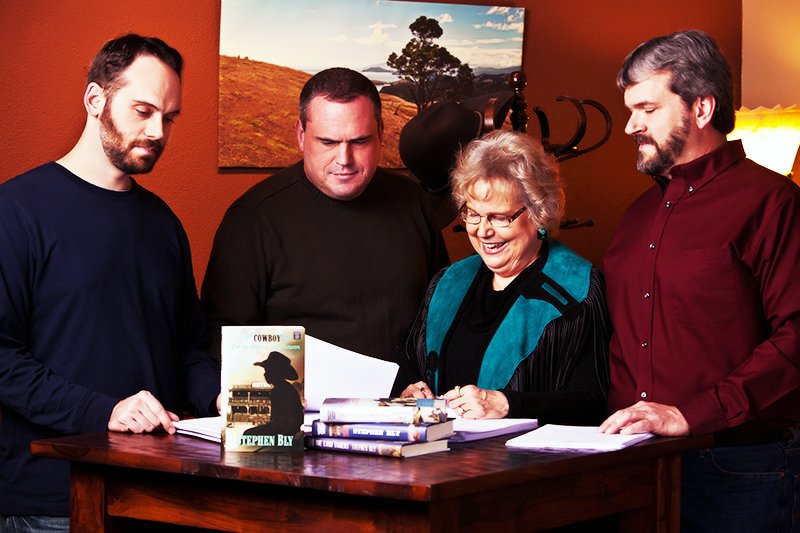
    My husband, Stephen Bly, hated half-done jobs. He couldn’t stand a ‘to do’ list without immediate action. One big task for 2011: complete his novel, Stuart Brannon: The Final Shot. When he passed away on June 9th, 2011, my sons said to me, “Let’s finish that book.” They suggested we do it as a family project.

    The idea grew. They had their dad’s creativity and wit. They’d collectively impart their father’s input. I also quickly discovered the value of their constant feedback and encouragement. I couldn’t do it without them.

    How Family Project Began

    The Center Point Thorndike Press editor gave us a four-month extension. This incomplete project became a family affair. Can a committee write a novel? We had the passion to find out.

    Steve left us one completed chapter, a synopsis (with no suggested ending), and lots of character names. We carefully studied these details. “It reads more like a mystery than a western,” we four surmised.

    This book must resonate like a Stephen Bly novel and resemble the early Stuart Brannon Series. Yet, this story’s different. Brannon’s older. He struggles to fit into the 20th Century. He also grapples with the game of golf on behalf of a celebrity charity tournament.

    The Family Process

    We immersed ourselves in the original 6 books of the series. Then, we scanned other Stephen Bly novels for Stuart Brannon mentions. I scoured Steve’s resources for a basic grounding in the western world he knew so well. I also skimmed our fiction writing books for tips and printed out excerpts for the sons. We finally decided to focus our main theme on fighting for justice, truth and mercy as we met weekly for the family project to brainstorm and critique.

    Starting with a cluster diagram of all the known factors, spirited discussions stirred debate as well as consensus. We assigned each other research topics, then talked through and roughed out random scenes. After drafting an outline, listing plot points gave direction for which scenes to create next. We tried to include as much of Steve’s writings as we could.

    Keeping Project Focus

    To keep the constant additions discernable, I used a different color type each week that turned into a rainbow manuscript. Even with this trick and the outline, the key challenge remained to keep the story’s timeline straight. Then I took a trip to the Oregon coast, to discover and experience what Steve knew about the locale and we didn’t. This added much needed color and revealed critical mistakes.

    The deadline loomed as we aimed for 75,000 words. I struggled to eke out 2,000 words daily. When Aaron devised an adventure scene and Mike produced the golf tourney and poker game settings, I knew we’d hit the target count.

    After we actually exceeded our goal, we deleted scenes and characters that didn’t move the plot. This tightened the action and made it better. The last days and hours filled with frantic attempts to get this family project as perfect as possible.

    At 10:36 a.m. on November 1st, 2011, son Mike emailed me, “Well? Ready to push ‘send’?” At 11:46 a.m., I did. We finished Steve’s last undone earthly task.

    Janet Chester Bly
    Copyright©2012

  • When Bad Things Happen to Those You Love

    When Bad Things Happen to Those You Love

    When Bad Things Happen to Those You Love

    As if she didn’t have enough bad things happen. Years of wealth and luxury, but now she had only the dress on her back. A reputation and status of being one of the country’s leading ladies, however now she roamed garbage dumps for a meal. Her large, healthy family had been the pride of her life, but now childless. 

    And her healthy, vibrant, dynamic husband turned into a pitiful, broken down, sore infested old man. More than enough for any gal to handle. On top of that, her husband was a religious fanatic who sat around wondering what God tried to tell him through all this.

    Mrs. Job said: “Do you still hold fast your integrity? Curse God and die!” (Job 2:9) 

    What should we do when bad things happen to those we love? 

    SEVEN REASONS BAD THINGS HAPPEN 

    1. Sometimes they come by divine appointment.

    Job faced the outcome of spiritual warfare. That conflict continues in our day. There’s a sense in which every bad event is ruled over by God, since He reigns sovereign over all things. But when we seek, we can discover several more immediate causes. 

    NATURAL CATASTROPHES

    • Sometimes bad things happen through natural catastrophes.

    The earth quakes, volcanoes erupt, waves pound, fires jump creeks, bridges collapse, plagues surge across a nation. We do not live in a perfectly safe world. The Bible says that rebellion against God caused the world’s present upheaval. Still, we look for explanations.

    If God used natural disasters to eradicate sin, who would be left? He did that once and only eight survived the flood on Noah’s ark. The tower in Siloam fell as one of the many tragedies possible in a sin-tainted world.

     THE WORLD’S SYSTEM

    • Sometimes bad things happen because of trials and tribulation. 

    The tenor of society, the flow of civilization, the dominating ideas of the world’s system oppose God’s plan for His people. The collision of the wills of truth and lies produce tragic consequences.  

              Make a stand for good. March to support a biblical position. Protest for what you believe is right. You’ll likely find fervent, sometimes vicious opponents. This world produces much trouble.   

    FOOLISHNESS, GREED, AND BLOWING IT 

    • Bad things happen because of stupid actions. 

    By example, King Hezekiah caused the suffering devastation of Babylonian plunder for a future generation by his lack of discretion and wisdom (2 Kings 20). 

    • Because people give Satan an entry.

    Judas had a problem with greed, which led to betraying Jesus. Judas gave Satan direct control of his life (Luke 22). 

    • The result from personal sin.

    The man near the pool of Bethesda in Jerusalem had a crippling disease for thirty-eight years. Jesus healed him, then presented a challenge: “Do not sin anymore, so that nothing worse may befall you” (John 5:14).

              An alcoholic ruins his liver. A prostitute suffers from a venereal disease. Habitual gamblers face bankruptcy.

    BEING A WITNESS 

    • Bad things sometimes happen when talking about Jesus.

    Peter and John received a stern warning. Then they got flogged when they disobeyed. 

    “We gave you strict orders not to continue teaching in this name, and behold, you have filled Jerusalem with your teaching and intend to bring this man’s blood upon us” (Acts 5:28,40).

    WHAT TO DO WHEN THOSE YOU LOVE FACE BAD TIMES

     First, stand by them.  

    “There is a friend who sticks closer than a brother” (Proverbs 18:24).  

    Second, practice being a kind listener. 

    “But let everyone be quick to hear, slow to speak, and slow to anger,” James advises (1:19). 

    Third, continue to show love. 

    “A friend loves at all times” (Proverbs 17:17). 

    Fourth, seek God’s counsel together. 

    “As for you, you meant evil against me, but God meant it for good” (Genesis 50:20).  

    MORE SUGGESTED ACTIONS WHEN BAD THINGS HAPPEN  

    Fifth, help them face responsibility. 

    “Faithful are the wounds of a friend” (Proverbs 27:6). 

    “Restore such a one in a spirit of gentleness; each one looking to yourself, lest you too be tempted” (Galatians 6:1). 

    Sixth, review God’s past faithfulness, provisions, and blessings. 

    Some things have gone right. Enjoy the loving memories and wonderful surprises, and re-live special events. 

    “When I pondered to understand this, it was troublesome in my sight, until I came into the sanctuary of God. Then I perceived their end” (Psalm 73:16,17). 

    When he grasped the long-range view of life, his heart and mind quieted in understanding.

    Seventh, chart together new goals and dreams. 

    Unexpected situations may crush certain plans made. Look for new opportunities. 

    GIVE GOD TIME 

    Eighth, allow God time to work His best result. 

    Some bad things take time to assess. God told Paul, “My grace is sufficient for you, for power is perfected in weakness” (2 Corinthians 12:9). 

    But that insight surfaced only after much pleading, praying, and questioning on Paul’s part. Many of life’s worst times have no easy quick-fix solutions or explanations.  

    CONCLUSION 

    Bad things do happen. But no one should face them alone. The message of Jesus, Emmanuel, God is with us! “In the world you have tribulation, but be of good cheer, I have overcome the world!” 

    Hallelujah! Amen & Amen.

    Stephen Bly signature

    Stephen Bly

    Circa 1990 

    ~~~~~~~~~~~~~~~~~~~~~~~~~~~~~

    CLICK HERE TO LISTEN TO SPOTIFY “When Bad Things Happen” Stephen Bly PODCAST: